- Phone: +91-9348425256
- Mon-Sat (8am - 6pm)
- skinfertilityinstitute@gmail.com

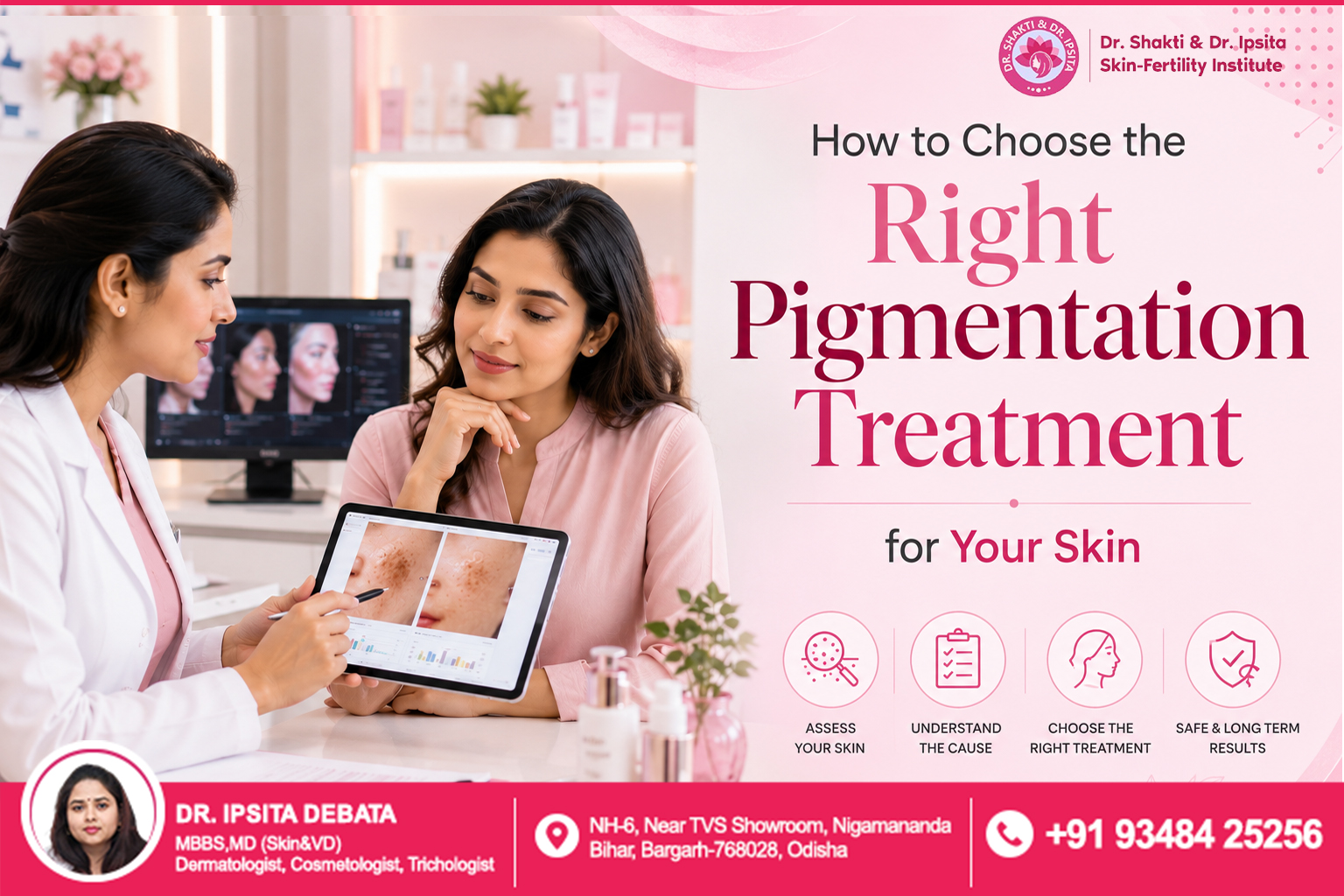
How to Choose the Right Pigmentation Treatment for Your Skin
Are you using expensive cosmetics to hide dark patches on your cheeks before getting ready for a party? Dark spots on the cheeks or uneven skin tone around the mouth can affect your overall look and your confidence, too. Have you ever wondered what causes dark patches or pigmentation, and which treatment is right for your skin?
Pigmentation can have different causes, and two people with similar-looking dark patches may have different causes. Melasma, post-acne pigmentation, and sun-induced pigmentation can respond differently to different treatments. That’s why the best dermatologist in Odisha advises ascertaining the underlying cause of pigmentation to choose the best skin treatment.
Explore this blog to learn how to choose the right pigmentation treatment for your skin.
Process of Choosing the Right Pigmentation Treatment for You
In this section, we will discuss the essential steps for choosing the right pigmentation treatment for your skin, as recommended by a dermatologist.
1. Find out what is causing your pigmentation
Before choosing a pigmentation treatment, the first step is to understand what you are actually treating. Pigmentation can develop for several reasons, such as sun exposure, melasma, acne, skin injuries, hormonal changes, and certain medications.
For example, the dark mark left after a pimple is not necessarily the same condition as symmetrical brown patches across the cheeks and forehead associated with melasma. That's why a professional skin assessment is vital to determine the best treatment for pigmentation.
2. Understand your skin type and tone
Depending on your skin tone, you need to choose a different pigmentation treatment. People with medium to darker skin tones are more prone to hyper pigmentation without expert guidance. In such cases, certain laser treatments can add more pigmentation to your skin. It does not mean that people with darker skin cannot undergo laser. It means you need to choose a pigmentation treatment based on your skin type and your dermatologist's advice.
3. Determine whether you have melasma or hyper pigmentation
Melasma commonly appears as grey-brown patches, particularly on areas such as the cheeks, forehead, nose, and upper lip. Due to hormonal imbalance and sunlight, melasma can worsen.
However, repeated sun exposure can cause dark spots and affect skin tone. Thus, it is vital to understand the difference between melasma and hyper pigmentation and choose the best medical treatment with the support of a top dermatologist in Odisha.
4. Do not consider laser the best option
Laser treatment is one of the most searched and best-ever solutions for pigmentation. However, laser treatment cannot automatically cure pigmentation. The treatment selection process depends on the pigmentation and individual skin characteristics.
People with darker skin tones need extra skin care to protect against pigmentation. So, rather than asking which laser removes pigmentation faster, ask which laser treatment is appropriate for your pigmentation.
5. Know when a chemical peel is necessary
Chemical peels are another option that works great for skin pigmentation treatment. A chemical peel can work well for pigmentation when done under the observation of a top cosmetologist in Odisha.
However, the usefulness of a chemical peel depends on several factors, such as skin type, skin sensitivity, previous skincare processes, and pigmentation history.
Conclusion
It is true that the effectiveness of pigmentation treatment depends on your skin type. When you choose a pigmentation treatment, make sure to have a detailed expert consultation. At Skin Fertility Institute, you can get expert dermatologist advice that can help you treat pigmentation and achieve youthful-looking, gorgeous skin.

About Us
We are the dedicated centre to addressing male sexual dysfunction, female sexual diseases, cosmetic gynaecology, vulvar clinic, hair transplant and all skin related problems.
ConsultationContact Info
- Dr. Shakti and Dr. Ipsita Skin Fertility Institute, NH-6, Near TVS Showroom, Nigamananda Bihar, Bargarh-768028, Odisha.
- +91-9348425256
- skinfertilityinstitute@gmail.com
- Week Days: 09.00 to 18.00 Sunday: Closed